
Market analysts project sustained growth at 5.8% CAGR through the next decade.
For textile manufacturers, selecting an industrial dyeing machine demands attention to crucial buying criteria. Performance, quality, and cost drive machine selection. Modern dyeing equipment achieves up to 44% water savings versus older models. This dyeing machine investment determines production efficiency for years.
Key Takeaways
- Match the dyeing machine to your specific fabric mix and production bottleneck, not just the lowest price.
- Lower liquor ratios cut water, energy, and chemical costs significantly, improving overall efficiency.
- Calculate total cost of ownership, including hidden costs like installation and downtime, to make a smart investment.
Aligning Machine Choice with Production Efficiency
Defining Your Production Bottleneck and Volume
Machine selection functions as a production strategy decision, not merely a technical comparison. Begin by analyzing your current line. Ask directly: “What is my primary bottleneck? Is it the dyeing process itself, or does preparation and finishing slow the flow?” This question determines whether you need faster equipment or more flexible machinery.
The most efficient mills do not choose one machine type. They assign the right machine to the right fabric. This approach delivers higher overall productivity, fewer bottlenecks, better machine utilization, and lower cost per kilogram. The key metric remains plant-level economics: total daily operating cost divided by total acceptable output.
Consider secondary operational indicators as well. Cycle time matters because faster cycles produce more batches per day. Loading capacity and process stability across batches also influence throughput. A counterintuitive insight emerges here: a machine with higher motor power and liquor ratio can still prove more efficient if it delivers faster cycle times and higher productivity, reducing total energy per ton.
Matching Machine Flexibility to Your Fabric Mix
Your fabric mix dictates equipment requirements. A mill processing both cotton and polyester blends needs machinery that handles different dye classes. A versatile HTHP jig dyeing machine or a multi-flow jet dyeing machine accommodates such variety effectively. Material compatibility directly impacts final quality and consistency.
Evaluate practical questions during supplier discussions. Ask about kilograms per day, total energy consumed per ton, process stability, reprocessing rate, and operator requirements. These metrics reveal true efficiency better than liquor ratio or motor size alone. Textile manufacturers should also consider whether a garment dyeing machine suits their product range. For denim production, an indigo slasher dyeing range combines dyeing and sizing in one process. For knitwear requiring trendy tie-dye effects, a DY series dip dyeing machine offers the solution. Each fabric dyeing equipment choice carries distinct advantages.
The cheapest machine often becomes the most expensive investment when measured against long-term operational costs.
Automated machinery speeds up production processes while enhancing precision and consistency. Real-world case studies demonstrate that optimizing lead times through technology integration yields significant efficiency improvements. Key performance indicators such as cycle time, throughput, and inventory turnover provide tangible evidence of gains. Selecting textile dyeing machines requires matching equipment capability to your specific production reality, not chasing specifications in isolation.
Categorizing Textile Dyeing Machines by Technology
Batch vs. Continuous: A Critical Crossroads
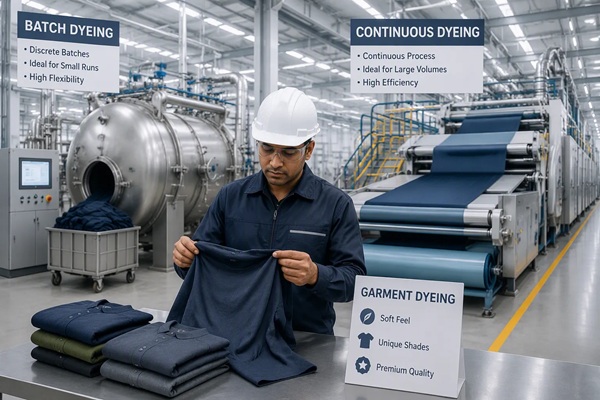
The first major decision separates batch processing from continuous operations. Batch dyeing machines process specific quantities, enabling precise color control for smaller fabric lots. This approach suits textile manufacturers handling diverse orders, special colors, or frequent style changes. The process operates in stages, requiring careful monitoring between cycles. Continuous dyeing machines handle larger volumes without stopping, maximizing output for mass production. Fabrics pass through a non-stop dyeing process, which increases speed but raises the risk of color inconsistency across long runs.
The cost structure differs substantially between these approaches. Batch processing carries higher cost per piece due to setup and cleaning between batches. Continuous systems deliver lower costs for large orders but demand higher initial investment in additional machinery. Water and energy consumption also diverge. Batch dyeing requires fresh dye baths and reheating for each cycle. Continuous operations reuse dye and heat, reducing resource consumption. The table below offers a head-to-head comparison of these two production models.
| Aspect | Batch Dyeing | Continuous Dyeing |
|---|---|---|
| Cost per piece | Higher | Lower for large orders |
| Speed | Slower for large orders | Faster |
| Flexibility | High | Low |
| Water & Energy Use | Higher | Lower |
| Initial Investment | Lower | Higher |
| Color Consistency | Small batch variations | Consistent across runs |
Specialized Garment Dyeing Machine Applications
Garment dyeing requires specialized equipment designed for finished apparel rather than raw fabric. A garment dyeing machine processes jeans, sweaters, and silk items with features tailored to delicate finished goods. Precise temperature control stands as a critical requirement. These machines offer direct and indirect heating, direct spray cooling, and water temperature detection systems. Maximum working temperature reaches 98°C with stable rising and cooling rates.
Automation features enhance consistency in garment dyeing operations. Optional full or semi-automatic controllers manage programmable processes. Feeding pump charging systems and automatic dosing tank control reduce human error. Stepless speed regulation protects delicate fabrics while ensuring proper dye penetration. These capabilities make the equipment versatile across fashion apparel, knitted textiles, and synthetic materials like nylon and acrylic.
For denim production, an indigo slasher dyeing range combines dyeing and sizing in one process. This integrated approach streamlines production for textile mills focused on denim goods. For knitwear requiring trendy tie-dye effects, a DY series dip dyeing machine creates multi-color gradients popular among fashion brands. Each fabric dyeing equipment choice serves distinct market demands. Understanding these applications of fabric dyeing equipment helps buyers match machinery to their specific product lines.
Jet dyeing technology deserves special attention for knit fabrics. Jet machines operate with low fabric tension, essential for elastic and tension-sensitive knits. They provide excellent levelness and good dye penetration. Jig machines, by contrast, apply high tension and suit woven fabrics only. This comparison of jet dyeing technology against jig systems clarifies why knits require jet processing. An industrial dyeing machine selection must account for these material-specific requirements.
Evaluating Dyeing Machine Efficiency Metrics
Efficiency in dyeing extends beyond processing speed. True efficiency measures resource consumption per kilogram of fabric processed. Textile manufacturers must evaluate several standard performance indicators when comparing textile dyeing machines:
- Color consistency across batches
- Water and energy consumption per unit
- Downtime frequency and duration
- Yield rate of acceptable output
These metrics reveal the genuine operational impact of any fabric dyeing equipment choice.
Liquor Ratio and Its Direct Cost Impact
The liquor ratio—the volume of water relative to fabric weight—stands as the most influential efficiency parameter. A conventional process operating at a 1:15 ratio consumes dramatically more resources than a modern system at 1:5. The comparison below quantifies this difference:
| Key Performance Indicator | Conventional (1:15) | Proposed (1:5) | Improvement |
|---|---|---|---|
| Water consumption (L/kg yarn) | 15 | 5 | 67% ↓ |
| Energy consumption (kWh/kg yarn) | 2.1 | 1.7 | 19% ↓ |
| Operational cost ($/kg) | 3.20 | 2.50 | 22% ↓ |
Water heating accounts for most energy usage in wet processing. Reducing bath volume directly cuts water demand, thermal energy, and wastewater production. Lower ratios also enhance dye fixation when properly managed, reducing salt and auxiliary usage. This translates directly to lower cost per kilogram.
Traditional dyeing requires massive energy to heat large water tanks and dry wet fabric. Waterless methods like supercritical CO₂ run in a closed loop and fabric comes out dry, eliminating the drying step entirely. This structural difference explains why waterless technologies cut energy consumption by up to 60%, while water-based machines still require significant thermal energy for heating and drying.
Automation and Dosing Precision for Consistency
Modern dyeing machines incorporate automated dosing systems that control precise chemical addition. Computer-controlled recipe execution eliminates variability from manual measurement. Every batch receives identical chemical composition, forming the foundation for consistent color reproduction exceeding 95%.
Automated mixing and dispensing guarantee uniform distribution throughout the dye bath. System integration with other dyeing processes replicates identical conditions for every batch. This precision directly supports quality standards and reduces reprocessing rates.
Precise temperature control further enhances consistency. Automated systems maintain stable heating and cooling rates, protecting sensitive fabrics while ensuring proper dye penetration. Jet dyeing technology benefits particularly from these controls, as knit fabrics require careful temperature management to prevent damage.
For textile manufacturers, automation reduces labor costs while improving production reliability. The investment in sophisticated controls pays dividends through reduced waste, fewer rejected batches, and enhanced brand reputation. Equipment selection should prioritize these automation capabilities alongside mechanical performance.
Financial Modeling: Calculating Total Cost of Ownership
CapEx vs. OpEx: The Real Investment Picture
Purchase price captures attention, yet operational expenses dominate the true financial picture. A complete total cost of ownership (TCO) calculation follows this formula: TCO = Purchase Price + Installation + Training + (Annual Energy + Water + Maintenance Costs × Expected Lifespan). This dyeing machine investment extends far beyond the initial invoice.
Modern textile dyeing machines deliver dramatic operational savings. Replacing outdated equipment with current technology can yield payback periods as short as 1 to 10 months, driven primarily by utility conservation. This benchmark reflects industry data from similar mill upgrades.
Payback periods of 1 to 10 months are achievable when modern dyeing equipment replaces outdated machinery, with utility savings as the primary driver.
Energy-efficient features transform the cost equation. The STORM multi-flow high-temperature dyeing machine integrates air atomization, airflow, and overflow functions while reducing energy consumption. These savings compound annually, producing a lower cost per kilogram over the machine’s lifespan. Textile manufacturers must model these reductions against their local utility rates to calculate a realistic payback period.
Uncovering Hidden Costs: Installation, Training, and Downtime
Hidden expenses often exceed expectations. Installation requires foundation work, utility connections, and integration with existing production lines. Operator training demands both time and resources. Production downtime during transition reduces output temporarily. Each element adds to the total cost.
A structured framework for modeling payback period protects against oversight:
- Develop a strict framework for modeling the payback period, referencing industry benchmarks and historical data from similar mill upgrades.
- Factor in local utility rates for water, steam, and electricity.
- Include secondary financial benefits: increased throughput, reduced rework, and minimized waste disposal levies.
- Calculate the exact cost of a single redye batch on current equipment, then multiply by the current failure rate to expose the hidden financial drain of poor right-first-time (RFT) performance.
This analysis reveals the genuine efficiency of any industrial dyeing machine. Equipment with superior right-first-time performance eliminates costly reprocessing. Every avoided redye batch represents direct savings. The dyeing equipment choice must account for these operational realities, not just specifications. A comprehensive financial model transforms the dyeing machine investment from a gamble into a calculated decision with measurable returns.
Planning for Scalability and Environmental Compliance
Modular Design for Future Capacity Expansion
A five-year growth plan should guide every equipment decision. Textile manufacturers often purchase machinery sized for current output, only to discover capacity constraints within two years. The smarter approach evaluates modular expansion options before committing capital.
Consider these questions during supplier evaluations:
- Can the dyeing machine accept additional dyeing tubes or upgraded software controllers without full vessel replacement?
- Does the main circulation pump have capacity to handle an extra tube in the future?
- Will the control system support next-generation sustainable chemistries like bio-dyes, which require precise pH control and extended dwell times at lower temperatures?
A garment dyeing machine with modular architecture protects your investment. Adding capacity later costs far less than purchasing a second unit. The same principle applies to fabric dyeing equipment across your facility. Each textile dyeing machine should fit a defined growth path, not just today’s order book.
Meeting Effluent and Energy Consumption Standards
Environmental compliance is non-negotiable. Regulatory pressure intensifies globally, and textile dyeing machines face scrutiny on water usage, wastewater discharge, and greenhouse gas emissions. Wet processes produce 52% of industry GHG emissions, making dyeing a primary target for regulation.
| Regulatory Driver | Specific Impact on Dyeing Machine Selection/Operation |
|---|---|
| New government regulations | Drives adoption of waterless/low-water technologies to comply with stricter environmental standards |
| Water usage restrictions | Machines must reduce water consumption; supercritical CO₂ processes cut water use by up to 7 gallons per pound (60 l/kg) in the dye cycle |
| GHG emission regulations | Shifting to dry/waterless machines can reduce Tier 2 emissions by 79–89% |
| Wastewater discharge regulations | Closed-loop systems eliminate wastewater and process chemicals |
Check that machine construction uses corrosion-resistant stainless steel. Verify water consumption rates align with local regulations. A garment dyeing machine with low liquor ratio drums reduces both water and chemical usage. Temperature control precision also affects compliance, as stable processing temperatures minimize energy waste. Equipment that fails environmental standards risks fines or forced shutdowns. Choose models that meet today’s rules and anticipate tomorrow’s restrictions.
Mitigating Implementation and Operational Risks
Assessing Supplier Support and After-Sales Service
The purchase price captures attention during negotiations. Yet the true cost of an industrial dyeing machine emerges through years of operation. A machine that sits idle waiting for spare parts produces nothing. Textile manufacturers must evaluate supplier capabilities before signing contracts.
Several criteria determine after-sales service quality:
- Service Network Coverage: Analyze the supplier’s global and regional service network. A machine downtime should not lead to prolonged waiting for proprietary parts shipped from overseas.
- Guaranteed Response Times: Set strict requirements for technical support response times. The supplier must remain reachable when the machine fails.
- Spare Parts Lead Times: Establish maximum lead times for critical spare parts. The best suppliers maintain local or regional warehouses stocked with essential consumables and high-wear components.
- Service Level Agreement (SLA) Content: Review the SLA to ensure it covers remote diagnostics, routine maintenance audits, and emergency on-site interventions. The agreement must clearly define the escalation process for unresolved technical issues.
- Additional SLA Provisions: A robust agreement must also include provisions for software updates and schedules for routine maintenance audits.
The cheapest dyeing machine often becomes the most expensive investment. Poor support translates directly into extended downtime and lost production. A garment dyeing machine with reliable backup delivers better long-term value than a lower-priced alternative without support infrastructure.
Planning for Operator Training and Production Integration
A sophisticated machine remains useless without skilled operators. Advanced textile dyeing machines incorporate complex control systems, automated dosing, and precise temperature control. Operators must understand temperature control systems completely to achieve consistent results.
Comprehensive training programs reduce errors and improve quality. Factor training costs into the total investment calculation. Include time for operators to practice on the new equipment before full production begins. This preparation minimizes transition downtime.
Production integration requires careful planning. The new equipment must connect seamlessly with existing preparation and finishing lines. Material flow patterns may need adjustment. Communication protocols between machines require verification. Each element demands attention before installation day.
Textile manufacturers should develop a phased implementation schedule. Start with trial batches. Verify color consistency and quality metrics. Then scale up gradually. This approach identifies problems early, when corrections cost less. A garment dyeing machine integrated properly delivers consistent results from the first full production run.
The human factor determines success. Invest in training. Plan the integration. Protect your dyeing machine investment through preparation.
Selecting textile dyeing machines demands strategic thinking. These crucial buying criteria transform a daunting purchase into a calculated dyeing machine investment. The right equipment balances performance, quality, and cost. A garment dyeing machine must align with production efficiency goals. Another garment dyeing machine option may suit different fabric mixes. Evaluate total ownership costs. This framework guides supplier negotiations. Production continuity depends on proper training.
FAQ
How Does Liquor Ratio Affect My Operating Costs?
Lower liquor ratios directly reduce water, chemical, and energy consumption per batch. A machine operating at 1:5 versus 1:10 cuts water usage substantially. This efficiency translates into measurable savings across every production cycle.
What Should I Include in My Total Cost Calculation?
Calculate purchase price plus installation, training, and annual operating expenses multiplied by expected lifespan. Factor in energy-efficient features that reduce utility costs. This complete picture reveals the true dyeing machine investment required.
How Do I Choose Between Different Machine Types?
Match equipment to your fabric mix and production volume. Compare batch versus continuous systems for your specific needs. A garment dyeing machine suits finished apparel, while jet machines handle knit fabrics. Review applications of fabric dyeing equipment before deciding.
Post time: Aug-25-2026